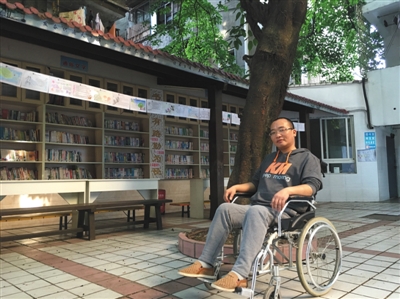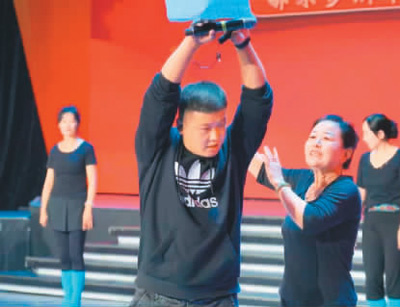
Xu Xiaoping (middle) is directing the rehearsal.
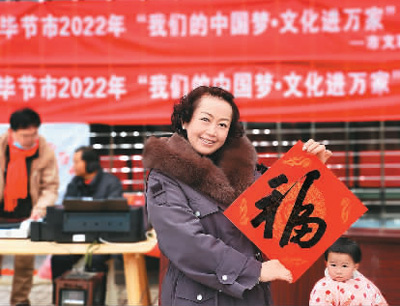
Sun Manjun was at the scene of the series of activities to welcome the Spring Festival culture and benefit the people.
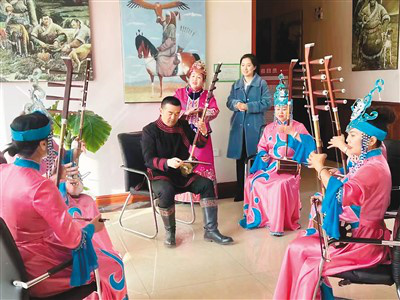
Jin Shikuan (middle)

Xu Naiping (left)
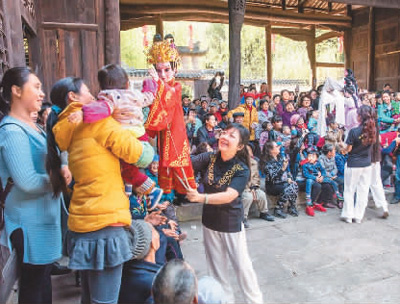
Sugar man interacted with the audience in the performance.

Zhang Haibo (right)
Let Wulan Muqi go to a broader stage.
■ Ordos City, Inner Mongolia Autonomous Region, Xu Xiaoping
The villagers sat around the bus, dancers danced in front of the bus, and the sound of Ma Touqin echoed in the grasslands. The dance is elegant, the music is melodious, the singing is ethereal, and it seems that there are bursts of bells &hellip in the distance; … This is Ejinhoro Banner in Ordos City. At the moment, my team members of Wulan Muqi in Ejinhoro Banner and I are performing the dance "Bells Shake Happy Songs" for farmers and herdsmen.
In 2005, at the age of 17, I joined Wulan Muqi. The Mongolian original meaning of Wulan Muqi is "red bud", which was later extended to "red literary light cavalry". It is a cultural work team born to adapt to the characteristics of production and life in grassland areas. For more than 20 years, I have traveled to more than 100 Gacha villages in Yijinhuoluo Banner, with a cumulative journey of more than 260,000 kilometers. At most, I performed more than 200 performances every year, and I spent one third of the year performing in rural areas in agricultural and pastoral areas. Now he is the vice captain of Wulan Muqi in Ejinhoro Banner. He once participated in the creation of "Happy Song of Bells" and won the 14th China Dance "Lotus Award" for ethnic and folk dance.
I am a native of Ejinhoro Banner. The climate here is dry and windy. When performing at the grass-roots level, the wind blocks the road and cars get stuck in the sand from time to time. In Ejinhoro Banner, which is sparsely populated, the herdsman’s settlement is often hundreds of kilometers away, and my team members and I often go for ten days or even dozens of days, so it is common to sleep outdoors. Going deep into the grassroots all the year round, all kinds of hardships are unimaginable. My wife is also a dancer. My husband and wife have always insisted silently, taking the sky as the curtain and the ground as the stage. Wherever there are people, there are our songs and dances.
Once, we went deep into the pastoral area to perform for the herdsmen. At that time, the weather was very bad and it was raining, but we still insisted on completing the performance, and the herdsmen accompanied us to the end. After the performance, the audience applauded and cheered for us, which made me very moved and gave me the motivation to continue to participate in grassroots literary and artistic work.
In addition to cultural performances, every time we go to the grass-roots level, we will also actively participate in voluntary service, send books, medicine and movies, repair cars and feed horses to shear wool. Wulan Muqi is not only a literary team, but also a coaching team and a service team. In order to improve my creative ability, I have participated in the dance creation class of the National Art Foundation for many times. I hope that my Wulan Muqi can go to a broader stage and show its elegance to the world. (Interview by our reporter Qi Qinqi)
Spread in a form that the masses like to see and hear.
■ Sun Yujun Bijie City, Guizhou Province
I have been doing grassroots mass cultural work since I joined the work, and it has been more than 20 years. I studied dance. In the early years, I worked as a dancer in the city’s art troupe and often performed in towns and villages with the group. Later, I worked as a director and director of song and dance performances in the city cultural center and became a planner and organizer of sending culture to the countryside. Although the role has changed, the sense of participation is stronger.
Every month, we organize cultural activities. During the Spring Festival this year, the Municipal Cultural Center organized activities to write Spring Festival couplets, arranged a photo exhibition, and took family photos for the villagers. Everyone was very happy. Sometimes there are cultural performances, about a dozen programs, which usually last for more than an hour. Although the time is not long, it will take about a month to prepare in the early stage to ensure that the programs performed for the masses are wonderful enough.
There are many ethnic minorities in Bijie City. Every time we go to towns where ethnic minorities live in concentrated communities, we will prepare special programs for them, such as yi dance and Miao songs and dances. On special festivals, such as the Year of the Yi People and the Flower Slope Festival of the Miao People, actors will also go to the scene to sing and dance to create a cheerful festive atmosphere.
In order to attract more people and make the scene more lively, the main venue for our performance is the villagers’ square, or the wide place at the door of ordinary people’s homes. Sometimes, the performance will be integrated with policy propaganda, such as urban and rural residents’ medical insurance policies, laws and regulations, etc., and spread in a way that the masses like.
I have been doing grass-roots literature and art work for many years, and I obviously feel the increase of people’s participation. In the past, I helped villagers rehearse programs. Although they were willing to participate, they felt that they were just a pastime and didn’t care at all. Now, the masses will spend their own money to buy costumes, rehearse in advance, and strive for better program results.
The villagers’ mental outlook has taken on a new look. They used to sit under the stage and watch passively. Now, they are more eager to show themselves on the stage. I was deeply impressed once. When we finished the performance, the villagers strongly asked us to stay and watch their square dance, and we readily agreed.
The problem of food and clothing for villagers has long been solved. What we have to do is to enrich their cultural life. Every time I go to the grassroots level, I will be very satisfied to send a variety of programs to the people and get recognition. I intend to continue to do mass cultural work. After all, for literary and art workers like me, "Gold cups and silver cups are not as good as the reputation of ordinary people!" (Interview by our reporter Chen Yiyi)
Protecting and Inheriting Daur Culture
■ Jin Shikuan Qiqihar City, Heilongjiang Province
I am a grass-roots literary and art worker in Meilisi Daur area of Qiqihar City, Heilongjiang Province. A job change in 2007 made me a member of Meris Cultural Center. When I first set foot on this land, the distinctive folk customs attracted me. Music made me attached to this land, and it was hard to give it up from then on.
Sihu, for me, is not only a musical instrument, but also a symbol of Daur culture. As an accompaniment instrument of the national intangible cultural heritage project "Wuqin of Daur nationality", Sihu has a unique timbre and melody. To this end, after entering the cultural center, I studied Sihu. How to master playing skills quickly? I started with learning erhu performance, and deeply studied the music history and cultural background of Daur nationality, and gradually integrated the unique charm of Daur nationality into Sihu performance. After finishing my studies, I volunteered to carry out the teaching of "Four Lakes" in the cultural center, and trained thousands of people before and after.
The Daur nationality has a profound historical background and charming charm. However, with the development of the times, Daur literature and art are facing the risk of no successor. How to make more people know and fall in love with Daur literature? I wrote songs such as "Auspicious Daur" and "Purple Fragrance in Spring". There is no written record of Daur language, and the ancient songs passed down from mouth to mouth are facing extinction. In view of this situation, I have excavated and compiled nearly 100 Daur’s "Wuqin" rap and "Hack Maile" dance accompaniment, and compiled them into a book to help Daur’s intangible cultural heritage be protected and passed down.
I have encountered many difficulties, but I have also met many like-minded partners, and I am even more fortunate to see the government send cultural heritage to the campus and bring it into thousands of families. Whether it’s going into school to teach children to dance Daur dance or going into the community to bring colorful cultural activities, every performance and exchange can make more people feel the unique charm of Daur culture. Everyone’s love for Daur culture is my courage to move forward.
In 2024, I was appointed as Deputy Secretary-General by Qiqihar Intangible Cultural Heritage Protection Association, which is not only an affirmation of my past work, but also an expectation of my future responsibilities. I am eager to make Daur culture glow with more dazzling brilliance through my own efforts! (Interview by our reporter Guo Xiaolong)
Behind the scenes are serving the masses.
■ Xu Naiping Xining City, Qinghai Province
In 2007, I came to the Cultural Center of Chengxi District from the former Xining Qin Opera Troupe, and it has been more than ten years now. When I was 14 years old, I was admitted to the student class of Shaanxi Chang ‘an Troupe to study the performance of traditional operas (Shaanxi Opera). It took me more than 30 years to rehearse a large number of modern operas, costume dramas, traditional operas and self-made dramas. I played 50 or 60 different roles, performed more than 200 performances on average every year, traveled all over Qinghai’s urban and rural areas and five northwestern provinces, and participated in provincial, municipal and national drama (opera) competitions for 30 or 40 times, and got good results every time.
The creation of stage works has always been my dream, but I didn’t expect it to become my main job after I arrived at the cultural center. Someone asked me, "What is the biggest difference between being in a troupe and a cultural center?" I replied, "The former should stand in the center of the stage, and the latter should push the masses to the center of the stage."
To tell the truth, I cried a few times during the reform of the Literary and Art Troupe in 2007: the long-established professional troupe "Xining Qin Troupe" was gone. What should I do after leaving the stage? However, after in-depth understanding, I found that the masses have a strong demand for drama performance and drama creation.
How to create works that the masses like to see and hear? After extensive research, I found that the works are not too long, and the capacity is not too large, which shows that one thing is reasonable. Therefore, sketches, skits, allegro, sitcoms and folk art have become the best forms of works.
Works can’t work without a platform, let alone without collaborators. Without a platform, the audience can’t see new works, and without collaborators, the works can’t be displayed brilliantly. Fortunately, there are many mass cultural teams, which provide me with collaborators and platforms.
The length and amount of information of the works I created are not large, but they are full of connections, joys and sorrows, singing, reading and playing, summing up in practice, perfecting in summary and forming in perfection … … In the process of creation, I am completely immersed in my work, and I feel that I can serve the masses with easy-to-understand work style and performance style, and I will be happy. Sometimes, I can play one of the roles and live an addiction to my old job.
Today, I am the chairman of Xining Dramatists Association. In my long career, I have always insisted that mass culture should keep up with and reflect the times. We should serve the society and the masses and be a literary and art worker based on the masses. (Interview by our reporter Jia Fengfeng)
The wooden stick is passed down from generation to generation.
■ Zhang Jing Fengdu County, Chongqing
I am 53 years old. I am the third generation representative inheritor of Chongqing Fengdu non-legacy wooden stick opera and the head of Yibai Puppet Art Troupe in Fengdu County. It was nearly 30 years ago that I became attached to puppet shows.
I used to work in a scenic spot in Fengdu County. In 1995, in order to attract more tourists, the unit set up a puppet show team, and I was one of them. At that time, we didn’t know anything about puppet shows, let alone how to perform them, so the unit hired professional teachers from other places to give guidance. Starting from basic training, after half a year of hard training, we gradually entered the door.
In those years, there were many domestic and foreign tourists visiting Fengdu, and puppet shows were very popular among tourists, with more than 8 performances every day. Gradually, I fell in love with puppet shows. In 2016, I set up my own art troupe. At that time, I knew that there had already been a puppet show in Fengdu — — It’s just a wooden stick opera, and it’s still a county-level intangible heritage in Fengdu. In order to better inherit and develop the wooden stick opera in Fengdu, I worshipped the local master and went out of Fengdu to learn from domestic professional academies.
Our team is an active participant in local mass cultural brand activities. In 2017, it was included in the service team of literary volunteers belonging to the County Cultural Center. At that year’s Fengdu Temple Fair, we performed publicly for domestic and foreign tourists and the general public. Everyone was attracted by our original wooden stick opera, and the performance lasted for more than 50 minutes, which made many viewers stare. During the 7-day temple fair, we performed two performances every morning and afternoon, and the venue was full. Some viewers were not satisfied with one performance, and then they watched the second and third performances, and the team members enjoyed themselves.
The audience’s love gives us great confidence. We have also created and rehearsed a series of wooden stick dramas according to Fengdu folk stories, and directed small plays such as Singing a Folk Song for the Party, Dancing in a Dress and Feather, and Greeting the Puppet according to different activity themes.
The growth and progress of the team can not be separated from the support of the masses, and we regard giving back to the audience as the most important thing. While creating and rehearsing the wooden stick drama, the team continued to participate in nearly 100 performances in Fengdu County during the annual temple fair, as well as activities such as entering the campus and sending culture to the countryside, and participated in thousands of normalized performances in famous mountain scenic spots. The performances received a total of 800,000 tourists. Although very tired, they were very happy. (Interview with Kang Pu and Li Dayuan)
The creation of ice and snow is hot
■ Jilin City, Jilin Province, Zhang Haibo
On the fifth day of Lunar New Year’s Eve, there was a lot of people in the ski resort, and a sitcom was staged at Vanke Songhua Lake Resort in Jilin City. On that day, I played a historical figure and staged a "cross-time dialogue" in the ice and snow. The New Year in the ski resort is a microcosm of the cultural tourism activities in Jilin Province. As the deputy head of Jilin Opera Troupe Co., Ltd., I led a team to actively participate in the publicity of ice and snow tourism, making laughter more full in the ice and snow.
I have been interested in traditional Chinese opera since I was a child. After graduating from local opera major in 2003, I took to the stage and devoted myself to the creation and performance of Errenzhuan and Jiju Opera. Over the years, I have been down-to-earth and worked hard to create works with temperature. In 2023, I led a team to participate in 273 performances. Whether in the fields or on the theater stage, the happiest thing is always to see the audience smile from the heart.
Creation comes from the fiery life. In July 2023, the large-scale modern Ji Opera "Happy Flowers Bloom" was staged in Jilin People’s Grand Theatre after repeated polishing, and the response was enthusiastic. The play depicts the prospect of rural revitalization and shapes the image of rural party member cadres serving the people wholeheartedly. In the process of creating a row, the main actors and I went to Sandaohezi Village, Dashitou Town, Dunhua City, Jilin Province to experience life, sat on the kang and listened to the prototype of the story to tell our personal experience, and went into the processing factory and cattle breeding base to experience it and understand the real story. The creative team gained a lot when they came back from collecting wind.
In recent years, Jilin City has actively promoted the activity of "Opera Entering Campus" to let children feel the charm of literature and art on campus. In 2023, "Opera on Campus" performed 10 performances in 10 schools in the city, and I participated in every performance. On campus, we perform excerpts from the plays of model figures such as Jiao Yulu and Huang Danian, as well as traditional plays such as Decisive Cases in Hu County, as well as handkerchief stunts and other programs that are popular with children. A few years ago, I participated in more than 100 large-scale modern Ji Opera "Huang Danian" jointly created and arranged by Jilin Opera Troupe and Jilin Song and Dance Troupe.
Happily, the just-concluded Jilin Errenzhuan Drama Sketch Art Festival was announced, and I won the honor of being one of the "Four Famous Ugliness". This also inspired me to continue to work hard and take every performance seriously.
Spring returns to the earth, and in the new year, we will continue to take root in the masses and create and perform works with more life flavor. (Interview by our reporter Zheng Zhiwen)
People’s Daily Overseas Edition (12th edition, March 21st, 2024)