Ruian City, Zhejiang Province released an investigation report on the consumption of skin care products in 2020.
Everyone loves beauty, and all kinds of skin care products have become an important part of consumers’ daily consumption. However, in the face of a wide variety of skin care products on the market, how do consumers in Ruian want to do it? What is the consumption situation? In June, 2020, the Consumer Rights Protection Committee of Ruian City launched a two-week "Investigation on Consumer’s Consumption of Skin Care Products in Ruian City". The activity was mainly in the form of questionnaires. The consumers in Ruian City forwarded and collected questionnaires through WeChat Questionnaires, and grassroots consumer rights organizations and volunteers distributed paper questionnaires to consumers. A total of 1,200 valid questionnaires were collected. The survey results and analysis report are as follows:
First, willing to spend money to protect "face", the middle and upper grades are popular.
Who doesn’t love beauty? The survey results show that the age group with high attention to skin care products is 19 -58 years old, covering a wide range. From teenagers who have just grown up to middle-aged and elderly people who are about to retire, Ryan’s old and young are willing to try to spend money to add points to beauty. But which price do they prefer for skin care products? (See Figure 1) Statistics show that 38.24% of consumers spend an average of monthly on skin care products in 100 yuan -500 yuan, 28.43% in 500 yuan -1000 yuan, and 17.65% spend more than 1000 yuan, with the least spending below 100 yuan. As can be seen from the data, high-end skin care products have become the main choice of consumers in Ruian, but there are also many beauty lovers who are willing to choose high-end skin care products that spend more than 1000 yuan every month in order to help them maintain their beauty.
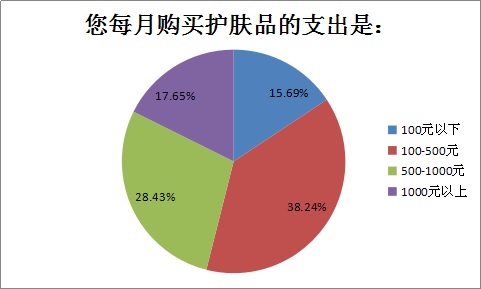
figure 1
Second, please don’t be too surprised that men also use skin care products.
In the inherent consciousness of the public, skin care products are considered to be exclusive to women, but with the popularization of maintenance consciousness, more and more men have begun to pay attention to the "face" project. The survey results show that 75.49% male consumers in Ruian have the habit of using skin care products in their daily lives. However, only 30.39% of men are using men’s skin care products (see Figure 2), and the rest of male consumers are casually using their family’s skin care products, or although they have their own skin care products, they are not men’s skin care products. Indeed, compared with the massive publicity of women’s skin care products in the market, there are only a handful of consumer guidance for men’s skin care products, and most of them are limited to cleaning products such as facial cleanser, while other men’s skin care publicity such as moisturizing and hydrating, cream or aftershave care is rare. Eighty percent of consumers think that the varieties of men’s skin care products need to be further enriched. Therefore, if the skin care industry can concentrate on developing the market and strengthen the scientific consumer guide of skin care products among male consumers, it will be a win-win situation for consumers or businesses themselves.
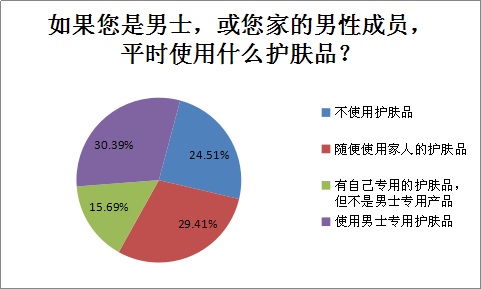
Figure 2
Third, change products according to changes, and complete cleaning and hydrating.
For skin care, consumers in Ryan are serious. They are not only willing to spend money, but also adjust their skin care products according to various changing factors. According to the survey, 71.57% consumers will choose skin care products with different functions according to their age and seasonal changes (see Figure 3). The market segmentation of skin care products beautifies people who love beauty, and also provides businesses with unlimited business opportunities.

Figure 3
According to the data (see Figure 4), consumers pay the most attention to face cleaning, with the usage rate of facial cleanser being 95.10%, followed by the usage rate of toner emulsion, essence, eye cream and face cream, ranging from 71.57% to 87.25%, indicating that consumers can cover all the steps of hydrating and moisturizing after daily face cleaning, which has become a normal life. The use rate of sunscreen is unexpectedly high, which shows that more and more consumers understand the direct relationship between sunscreen and anti-aging, and the awareness of sunscreen and skin care has been gradually enhanced. Mask is a key product widely advertised by skin care products merchants in recent years, as if the more masks are used, the more beautiful and young they can be. However, the lowest usage rate of facial mask in this survey is 58.82%, which just shows that consumers in Ryan have been able to judge themselves from their actual situation and choose reasonable skin care consumption. In fact, high-frequency use of the mask can not only be absorbed by the skin, but also cause cosmetic dermatitis, contact dermatitis and other problems due to long-term contact with preservatives and additives in the mask, so it is generally enough to apply the mask 2-3 times a week.
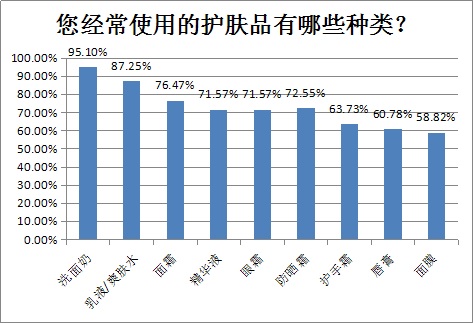
Figure 4
Fourth, prefer international brand rotation, trust friends’ recommendation and efficacy.
The competition in the skin care industry is fierce, and there are many kinds of products. In the choice of skin care brands, it can be seen from the data (see Figure 5) that more consumers prefer international brands. They think that the cosmetics of international brands are more effective, the ingredients are more natural and pure, and it is easier to get psychological satisfaction. However, there are still 27.45% consumers who are determined to buy domestic brands. The main reasons are: first, domestic brands have high cost performance; second, domestic brands have many purchase channels and strong convenience.
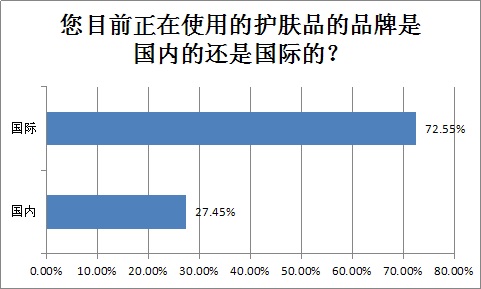
Figure 5
What is the loyalty of consumers after choosing brands? According to the survey results (see Figure 6), only 15.69% of consumers said that they "only use a certain brand of skin care products regularly and don’t intend to change them", and most consumers belong to several brands to buy or are still looking for a more suitable brand. These rational consumption behaviors of consumers undoubtedly require skin care companies to constantly improve brand quality, constantly upgrade products and innovate services.

Figure 6
Whose recommendation can win the trust of consumers more? What factors do consumers mainly consider when purchasing skin care products? Through the survey results (see Figures 7 and 8), "others’ recommendation", "word of mouth" and "efficacy" have overwhelmingly become the first choice criteria for consumers to choose skin care brands. Although there are more and more channels for consumers to obtain information about skin care products, including the Internet, newspapers, and counter publicity, consumers are more willing to rely on the recommendations of family and friends around them and their feelings about the efficacy of used skin care products, which shows the importance of consumer experience and word-of-mouth communication.

Figure 7
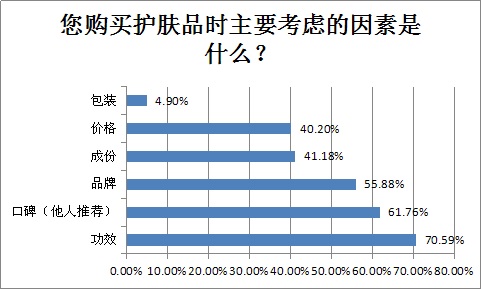
Figure 8
Fifth, the purchase channels are diversified, and assured consumption is the most concerned.
Ruian is a county-level coastal city in southern Zhejiang, with strong overall consumption capacity. However, due to the scale restrictions of small and medium-sized cities, many consumers can’t buy their favorite international skin care brands locally. The rise of e-commerce has brought convenience to consumers, and the channels for purchasing skin care products are showing a diversified trend: according to the survey results (see Figure 9), 50.98% of consumers give priority to purchasing skin care products, which shows that consumers in Ruian have high enthusiasm for cross-border consumption and rich and smooth channels; 46.08% consumers will choose online shopping for skin care products; As for the sale of skin care products in WeChat friends circle and live broadcast room (see Figure 10), consumers have encountered or heard many unpleasant consumption cases in their lives, so 77.45% of consumers said they were not at ease to buy skin care products in these two channels. In addition, cosmetics stores (43.14%), shopping malls and supermarkets (30.39%) are still the most commonly used channels for purchasing skin care products.
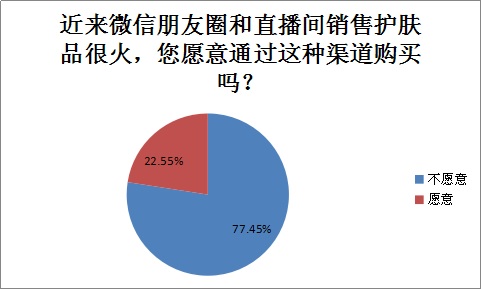
Figure 9
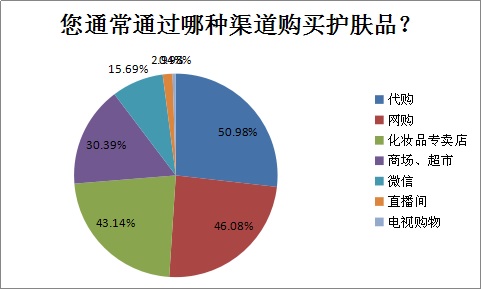
Figure 10
No matter which purchase channel consumers choose, the most important criterion is to be assured of consumption. However, even the cross-border purchasing and online shopping on the platform, which consumers choose most, are mixed. Especially, because there are many channels for cross-border purchasing, it is difficult to defend rights once the goods have quality problems, so the most worrying problem for consumers when shopping online is to buy fake and shoddy products (see Figure 11). In this regard, 92.16% (see Figure 12) of consumers think that online shopping for skin care products should support "no reason to return it within 7 days". Thus, if the problem of safe consumption is solved, the prospects of e-commerce and Wechat business should be brighter.

Figure 11
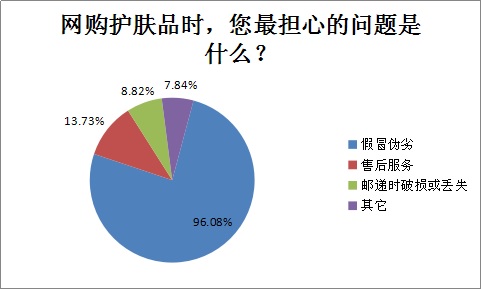
Figure 12
Therefore, the Consumer Protection Committee of Ruian City will call on all relevant government departments to improve the regulatory laws and regulations as soon as possible, uniformly implement standards, formulate convenient and efficient methods that conform to the characteristics of e-commerce, establish clear regulatory authority, carry out comprehensive law enforcement in multiple departments, strictly enforce the product access system, and standardize product information from the source.
In addition, consumers are also reminded to pay attention to the following points when purchasing skin care products online on cross-border e-commerce platforms:
1. Haitao skin care products are best purchased on a regular large-scale Haitao e-commerce platform, with global warranty service and a sound after-sales complaint mechanism. You can give feedback at any time if you have any questions.
2. For skin care products with low prices and unknown sources, be careful to buy them; It is best to use a third party to pay or choose a debit card to pay; It is difficult to defend rights in the future through informal means such as Wechat business and private chat.
3. The seller claims that the "counter inspection" is not credible, and the counter has no right and obligation to help consumers to inspect goods online. Because of the particularity of online shopping, it is very troublesome to obtain evidence. Consumers must pay attention to keeping transaction records, transaction information, screenshots of chat records with sellers, etc. When encountering merchants suspected of selling fakes, they should actively report their rights to the third-party regulatory authorities.
4. For the goods directly marked on the product page that do not support return, be sure to think twice before placing an order.
5. Consult the customer service staff in advance for the customs clearance fee and logistics fee to understand the basic fees, so as to avoid subsequent disputes over the fees. (Source: Ruian Consumer Protection Committee)