[Experts say] Say the antidote: Liuwei Dihuang Pill is not used properly or should be used with caution for those who have a cold.
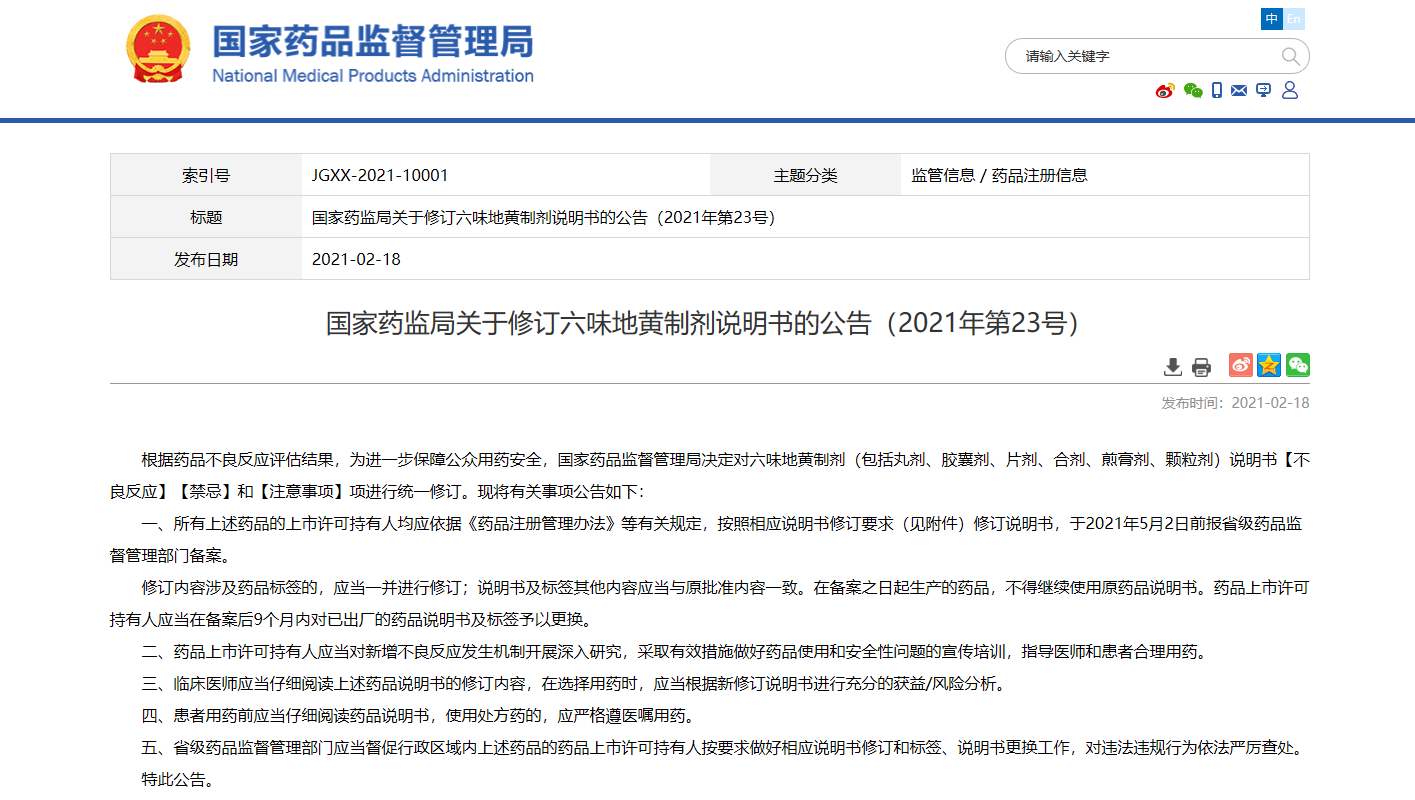
Cctv news(Reporter Zhang Ke): On February 18th, National Medical Products Administration issued an announcement in official website to revise the instructions of Liuwei Dihuang preparation. The announcement pointed out that according to the response evaluation results of adverse drug reactions, in order to further ensure the public’s drug safety, the instructions [Adverse Reactions] [Taboos] and [Precautions] of Liuwei Dihuang preparations (including pills, capsules, tablets, mixtures, decoctions and granules) were uniformly revised.
The instructions of Liuwei Dihuang preparation are revised for prescription drugs and over-the-counter drugs respectively. It is pointed out in the revision requirements of OTC drug instructions that [adverse reactions] should include: reports of adverse reactions such as diarrhea, abdominal pain, abdominal distension, nausea, vomiting, gastrointestinal discomfort, loss of appetite, constipation, itching, rash, headache, palpitation and allergy. In the modification requirements of items [Taboo] and [Precautions], the drug safety of allergic people is mentioned.
As one of the classic prescriptions of traditional Chinese medicine, Liuwei Dihuang Pill is well known to the public for its effects of nourishing yin and tonifying kidney, and was once called "essential tonic for families". How to eat this kind of "tonic", can it be eaten for a long time, and which people should not take it? CCTV reporter interviewed Yang Liping, the chief pharmacist of Beijing Hospital, to answer your questions.
The origin of "tonic medicine"
Liuwei Dihuang Pill is composed of six kinds of traditional Chinese medicines, namely Radix Rehmanniae Preparata, Fructus Evodiae, Cortex Moutan, Rhizoma Dioscoreae, Poria and Alismatis Rhizoma. It is characterized by "three tonics and three diarrhea" and mainly tonics. Yang Liping explained that the "three tonics" consist of Radix Rehmanniae Preparata, Fructus Corni and Rhizoma Dioscoreae to tonify liver yin, spleen yin and kidney yin respectively; "Three diarrhea" consists of three herbs, namely Cortex Moutan, Poria and Alisma orientalis, to purge liver heat, spleen dampness and kidney dampness. Among them, the dosage of tonic is heavier than laxative, so tonic is the main one; Liver, spleen and kidney are supplemented with three yin, and the dosage of Radix Rehmanniae Preparata for tonifying kidney yin is the sum of Cornus officinalis and Dioscorea opposita, so tonifying kidney yin is the main method. Therefore, Liuwei Dihuang Pill mainly has the function of nourishing kidney yin and is suitable for patients with kidney yin deficiency.
The prescription of Liuwei Dihuang Pill was formed by Qian Yi in Song Dynasty after subtracting two kinds of drugs from Shenqi Pill written by Zhang Zhongjing, a medical sage in the Eastern Han Dynasty, which changed the original medicine for warming kidney-yang into a medicine for nourishing kidney-yin. Its original intention is to treat children with congenital deficiency and stunted five-delay syndrome, that is, "the kidney is afraid of losing its voice, the mouth is incompatible, the spirit is insufficient, the eyes are white, and the face is white". Since then, Liuwei Dihuang Pill has gradually become the ancestor of nourishing yin and tonifying kidney. Modern physicians mainly use Liuwei Dihuang Pill to treat dizziness, tinnitus, soreness of waist and knees, hot flashes due to bone steaming, night sweats and nocturnal emission, thirst-quenching, tinnitus and deafness, hand and foot fever, dry mouth and throat, tooth shaking, heel pain, dribbling urine, and improper opening of the mouth in children.
Improper use or "the more you make up, the more empty you become"
Yang Liping said that it is unnecessary for healthy people to take Liuwei Dihuang Pill if they have no obvious symptoms of kidney yin deficiency, and they should not take it for a long time.
For people with obvious symptoms of kidney-yang deficiency, symptoms such as soreness and coldness of waist and knees, preference for warmth and fear of cold have already appeared, and it is not recommended to take Liuwei Dihuang Pill to avoid aggravating the condition. Many people regard Liuwei Dihuang Pill as a "secret recipe for tonifying kidney" or use it for daily health care for a long time, which is easy to "replenish more and more deficiency", some symptoms are getting worse and worse, and even gastrointestinal problems may occur.
Experts pointed out that if you want to know whether you can use Liuwei Dihuang Pills, you must first judge whether you are yin deficiency. You can first look at your tongue, such as red tongue and frequent dry mouth. See if there are often symptoms such as hot flashes, night sweats, insomnia, dizziness, and soreness of the waist and knees; Conditional can see the pulse, whether the pulse is thin and fast. With these signs and symptoms of kidney yin deficiency, Liuwei Dihuang Pill can be used. Even if it is suitable for eating, you should quit smoking and drinking and eat less irritating food.
Liuwei Dihuang Pill should be used with caution in patients with cold.
Compared with the previous instructions of Liuwei Dihuang Pill, the description of drug use for patients with cold has been changed from "It is not advisable to take cold medicine during taking medicine" in the original [contraindications] to "Use it with caution for patients with cold" in the [Precautions]. Yang Liping said that according to the theory of traditional Chinese medicine, Liuwei Dihuang preparation is too greasy and easy to retain exogenous pathogens, which violates the cold treatment principle of relieving exterior symptoms and dispelling pathogens. The key to cold treatment lies in opening pores, sweating and dissipating heat. However, the function of Liuwei Dihuang preparation is mainly to "harvest", which runs counter to the idea and direction of cold treatment in traditional Chinese medicine.
Therefore, people should stop taking Liuwei Dihuang Pill even if they have kidney yin deficiency during the cold stage, and then use it after the symptoms of exogenous diseases are relieved.
Who else should not take Liuwei Dihuang Pills? Yang Liping said that Chinese medicine treatment needs syndrome differentiation, and "syndrome differentiation first distinguishes yin and yang". For example, kidney deficiency syndrome can be divided into kidney yin deficiency and kidney yang deficiency. People with kidney-yin deficiency can show symptoms of lack of body fluids, such as dry mouth and mouth, dry skin, soreness of waist and knees, emaciation, hot flashes, red cheekbones, tinnitus, night sweats, red tongue with little coating, and weak and rapid pulse. People with kidney-yang deficiency are afraid of cold, and their hands and feet are cold; Frequent urination, long and clear urine, thin stool, pale and tender tongue, and slow pulse. Symptoms are completely different from kidney yin deficiency, so people with kidney yang deficiency should not take Liuwei Dihuang pills. Because Liuwei Dihuang Pill not only does not tonify kidney-yang, but also consumes kidney-yang, the symptoms of kidney-yang deficiency in patients will be aggravated after use.
In addition, people with kidney yin deficiency but poor spleen and stomach function have symptoms such as weakness of spleen and stomach, indigestion, chest tightness, anorexia, abdominal distension in loose stool, thick tongue coating, and excessive phlegm and dampness, and should not take it. Because the rehmannia glutinosa and Cornus officinalis in Liuwei Dihuang Pill are too greasy, it will hinder the digestive function after taking it, and may also aggravate the symptoms of loose stool, so it is not recommended to take it.
Also, healthy people don’t need to take it. Although Liuwei Dihuang Pill has the function of tonifying kidney, healthy people who have no obvious symptoms of kidney yin deficiency may not have any side effects in the short term, but long-term use may cause discomfort such as fullness, loose stool and loss of appetite.
Finally, note that Liuwei Dihuang Pill cannot be taken with rifampicin. Because Cornus officinalis contains a lot of organic acids, it will increase the toxicity of rifampicin to the kidney. (Proofread by Chen Yanhui)